Gamers Nexus Says Intel's $200 CPU Beats AMD at Its Own Game — the Benchmarks Back It Up
Gamers Nexus just ran Intel's Core Ultra 5 250K Plus through every benchmark they have. The verdict: at $200, Intel has finally built a CPU that's competitive with AMD across gaming AND production — and it might be the start of something bigger.
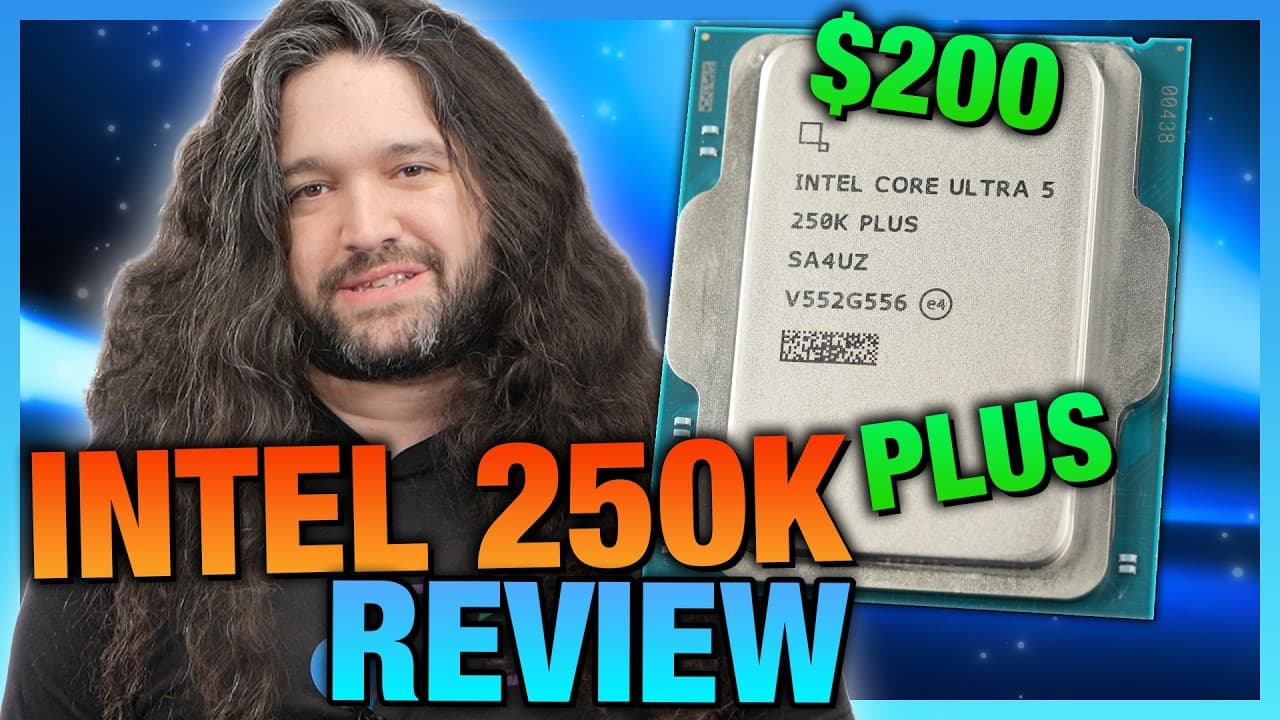
Gamers Nexus Intel Core Ultra 5 250K Plus review thumbnail
Key Points
•Intel's Core Ultra 5 250K Plus launches at $200 — the same price as its predecessor the 245K, but with four more E-cores (18 total) and 30MB of L2 cache
•Gaming performance is back to Intel 14th-gen levels after the disastrous original Arrow Lake launch — roughly matching or slightly beating the 14600K
•Production workload dominance: Intel beats AMD's $190 Ryzen 5 9600X by up to 71% in compression testing and 44% in Blender rendering
•A mandatory "Platform Performance Package" software install is required for the CPU to perform correctly — adding setup friction
•Gamers Nexus calls it Intel's "2017/2018 AMD Ryzen moment" — establishing a price-competitive foothold in non-gaming workloads
Intel Has Spent 18 Months Losing Ground
Intel has spent the last 18 months losing ground to AMD. The original Arrow Lake launch was, to put it generously, a mess — the 200-series CPUs launched at prices that didn't make sense, delivered performance that regressed from 14th gen, and left everyone wondering what happened to the company that used to dominate desktop processors.
The Core Ultra 5 250K Plus is Intel's attempt to fix that. Gamers Nexus just put it through an exhaustive benchmark suite, and the results tell a story that's actually worth paying attention to. [1]
Back to Basics, With More Cores
The 250K Plus costs $200. For that price, you get a reconfigured processor: 6 performance cores plus 12 efficiency cores for a total of 18 threads, running at up to 5.3 GHz boost. Compare that to the 245K, which ran a 6P + 8E configuration at 14 cores — and cost over $300 at launch. Intel didn't just give you a clock bump here. The core count change means different performance characteristics across workloads. [1]
There's also a 30MB L2 cache on the 250K Plus versus 26MB on the 245K. Not X3D territory, but meaningful for certain workloads.
One thing Intel made very clear to reviewers: you have to install the "Intel Platform Performance Package" (which Gamers Nexus's Steve Burke cannot stop calling the "PP package" — a choice that had his whole team laughing through the entire review process). This software enables correct CPU scheduling, core parking, and performance features. Without it, you're leaving performance on the table. Intel says the consumer version will only need one install; reviewers got a two-step process with a hot fix. Not great for first impressions. [1]
Gaming: Intel Is Back to 14th Gen (Finally)
In gaming tests across Baldur's Gate 3, Outer Worlds 2, Cyberpunk 2077, Starfield, and others, the 250K Plus generally performs at or near the 14600K level — Intel's previous i5 champion from a couple years back. That sounds like a modest achievement, but after the 245K launched below 14600K gaming performance, getting back to parity is genuinely significant. [1]
Where it beats AMD: the 250K Plus outperforms the Ryzen 5 9600X by 10-24% across multiple titles. Dragon Age 2 saw a 23% lead. Kingdom Come Deliverance 2 put Intel ahead by 10%. Even in F1 25 — a notoriously CPU-sensitive title — the gap was around 14%. [1]
Where Intel still trails: AMD's X3D lineup. The 5700X3D, 5600X3D, and obviously the 9800X3D all maintain leads in gaming, sometimes significant ones. The 5800X3D alone beats the 250K Plus by 14% in Cyberpunk. But those chips cost more, and the 250K Plus is a $200 CPU. The comparison that matters is versus the $190 9600X — and there, Intel wins consistently. [1]
Gamers Nexus ran over 15 games and production workloads on the 250K Plus. Credit: Gamers Nexus / YouTube [1]
Production: This Is Where Intel Actually Shines
This is the real story. In 7-zip compression testing, the 250K Plus runs 152,800 MIPS — a 71% lead over the Ryzen 5 9600X. Seventy-one percent. In Blender rendering, the 250K Plus finishes a complex render in 9.2 minutes versus the 9600X's 16.4 minutes — 44% faster. In Chromium compile tests, the gap is 100 minutes versus 133 for Intel. [1]
The 9600X is a six-core chip, and that core count ceiling matters enormously in production workloads. Intel's 18-core configuration doesn't have that ceiling. Even in Da Vinci Resolve and Adobe Photoshop, where AMD has traditionally been competitive, the 250K Plus either matches or slightly beats the 9600X. [1]
Gamers Nexus explicitly compared this moment to AMD's 1000/2000 series Ryzen launch in 2017-2018: when AMD came back to relevance not by dominating gaming immediately, but by establishing a real competitive foothold in production workloads and pricing. "It almost looks like Intel's going that direction right now," Steve Burke said in the review. [1]
The Intel Binary Optimization Tool: Don't Bother (Yet)
Intel announced a binary optimization tool that claims to reduce cache misses and improve CPU circuit utilization. In theory, this is cool — software that analyzes and optimizes your running programs at a hardware level. In practice, it currently only supports 12 games, and even Intel only claims meaningful gains in a couple of them. [1]
Gamers Nexus tested it in Cyberpunk 2077 (one of the two games in their suite that support it) and found essentially nothing — within margin of error. Final Fantasy 14 got a couple of percentage points. For now, this tool is a future promise more than a present feature. [1]
The RAM Problem Nobody Talks About
Here's the honest caveat that Steve Burke spent time on in the review: the CPU might cost $200, but the whole platform still requires DDR5, and DDR5 prices are genuinely rough right now. If you're building new, you're looking at significant memory costs on top of a $200 CPU. The processor itself is reasonably priced. The ecosystem surrounding it is not. [1]
Also worth noting: the 1851 motherboard socket is probably near end-of-life. Intel will likely do one more Arrow Lake refresh at most before moving to a new platform. If you're buying into LGA1851, you're not buying longevity — you're buying the CPU itself. AMD's AM4 support lasted nearly a decade; Intel's track record here is notably worse. [2]
The Verdict
For someone building a PC primarily for content creation, streaming, coding, or any production-heavy workflow, the Intel Core Ultra 5 250K Plus at $200 is a genuinely competitive option. You beat the 9600X by wide margins in production and you're close enough in gaming to not care about the delta. [3]
For pure gaming builds where you want the absolute highest frames, AMD's X3D lineup (particularly used 5800X3D or the 9800X3D) still wins. But those are different price points. [4]
Intel hasn't beaten AMD. But at $200, they've stopped losing. That's not nothing — it's actually the same path AMD walked in 2017 when they came back from the wilderness. The question is whether Intel can follow that script all the way through. [1]
Gamers Nexus will follow up with the Core Ultra 7 270K Plus review next. That's the one that competes directly with the 9800X3D territory. If Intel can hold ground there too, the comeback narrative gets a lot more compelling. [1]
On this page
Web · https://www.tomshardware.com/pc-components/cpus/where-to-buy-intels-core-ultra-5-250k-plus-and-core-ultra-7-270k-plus-grab-these-impressive-arrow-lake-refresh-cpus-from-these-retailers-starting-from-usd219