Forty Gadgets, One Viral Video, and the AI Invasion Nobody Saw Coming in Consumer Tech
Voltrix Gadgets dropped a '40 Amazing Gadgets for 2026' roundup that's racking up views fast. There are legitimately mind-blowing products in here — an AI hologram companion, a robot vacuum with a mechanical arm, a desktop copilot that rewrites your meeting notes in real time. There's also a lot of noise. We watched so you don't have to.
Voltrix Gadgets 40 Amazing Gadgets You'll Want to Own in 2026 — YouTube video thumbnail
Key Points
•Voltrix Gadgets' "40 Amazing Gadgets" video dropped March 23 and is already trending — a useful snapshot of where consumer hardware is heading in 2026
•AI is no longer just in your phone or laptop: it's in your desk lamp, your vacuum, your meeting speaker, and apparently coming for your companionship too (Razer Project AVA)
•The standout products are genuinely impressive — especially the SOS Z70 robot vacuum with a 5-axis mechanical arm, the DECOKEE Quake AI desktop copilot, and the Pimax Dream Air SE VR headset at under 140 grams
•Plenty of the 40 are gimmicks dressed up in slick YouTube packaging — the Tornado heater, the ice ball mold, and the titanium lighter are lifestyle products masquerading as tech
•The bigger story: 2026's gadget market isn't about one breakout device, it's about AI burrowing into every product category simultaneously
The Year Your Gadgets Got a Brain
Every few months, YouTube surfaces one of these videos: a gadget roundup with a title so maximalist it almost loops back around to honesty. "40 AMAZING Gadgets You'll Want to Own in 2026" from Voltrix Gadgets is exactly that. Forty products, rapid-fire, shot with the kind of production quality that makes everything look like it belongs on a shelf at a museum of the future. [1]
I watched the whole thing. And I'll be honest — there are about a dozen products in here that made me stop and look up whether they're actually real. That's not nothing. In a world of speculative concept renders and Kickstarter vaporware, finding even five genuinely impressive products in a 25-minute YouTube roundup is a win.
What struck me more than any single product, though, is the pattern. Almost everything in this video has AI in it now. Your lamp, your vacuum, your conference speakerphone, your massage roller, your desk calendar. The AI layer is no longer a premium feature — it's a baseline expectation, even for $119 gadgets. That shift happened faster than most of us were paying attention. [1]
Voltrix Gadgets' '40 Amazing Gadgets' video dropped March 23 and is already trending across tech communities. (YouTube / Voltrix Gadgets)
The Products That Are Actually Impressive
Let's start with the one that made me genuinely pause: Razer Project AVA. This is a 24/7 AI companion displayed as an animated 5.5-inch 3D hologram on your desk. She has a dynamic personality that learns through interactions, uses vision and audio sensing to understand your context in real time, organizes your schedule, helps with work tasks, and apparently coaches you through games. [1]
Is it a little uncanny valley? Yes. Is it also the clearest consumer-facing implementation of ambient AI companionship I've seen at any price point? Also yes. This is what the AI assistant pivot looks like when it's done in hardware instead of software. Apple wants Siri to be ambient. Amazon wants Alexa to be ambient. Razer went ahead and gave the thing a face and a holographic body and put it on your desk. Whether that's brilliant product thinking or a cautionary tale about where this goes, I'm not sure yet — but it's real and it ships.
The SOS Z70 is another standout that's harder to dismiss. Most robot vacuums got impressive and then plateaued. The Z70 breaks that ceiling by adding a five-axis mechanical arm that picks up socks, moves small obstacles, and organizes things around your home while it cleans. It has 22,000 pascals of suction, hot water mopping, a self-maintaining dock, and can navigate around 108 types of obstacles [1]. That last stat sounds like marketing, but the mechanical arm is demonstrably real — and it's the first time I've seen a consumer robot vacuum cross from "cleaning tool" into "household robot." That's a meaningful category shift.
The DECOKEE Quake is an 8.8-inch AI desktop copilot built from CNC-machined metal with customizable RGB. It summarizes meetings, does real-time language translation, builds voice-activated shortcuts, and integrates directly with creative tools like Photoshop, Premiere, and Office [1]. As someone who spent years in dev workflows drowning in context-switching, the idea of a dedicated physical device for AI-assisted productivity hits different than another software app. Whether it executes well is a different question, but the concept is directionally right.
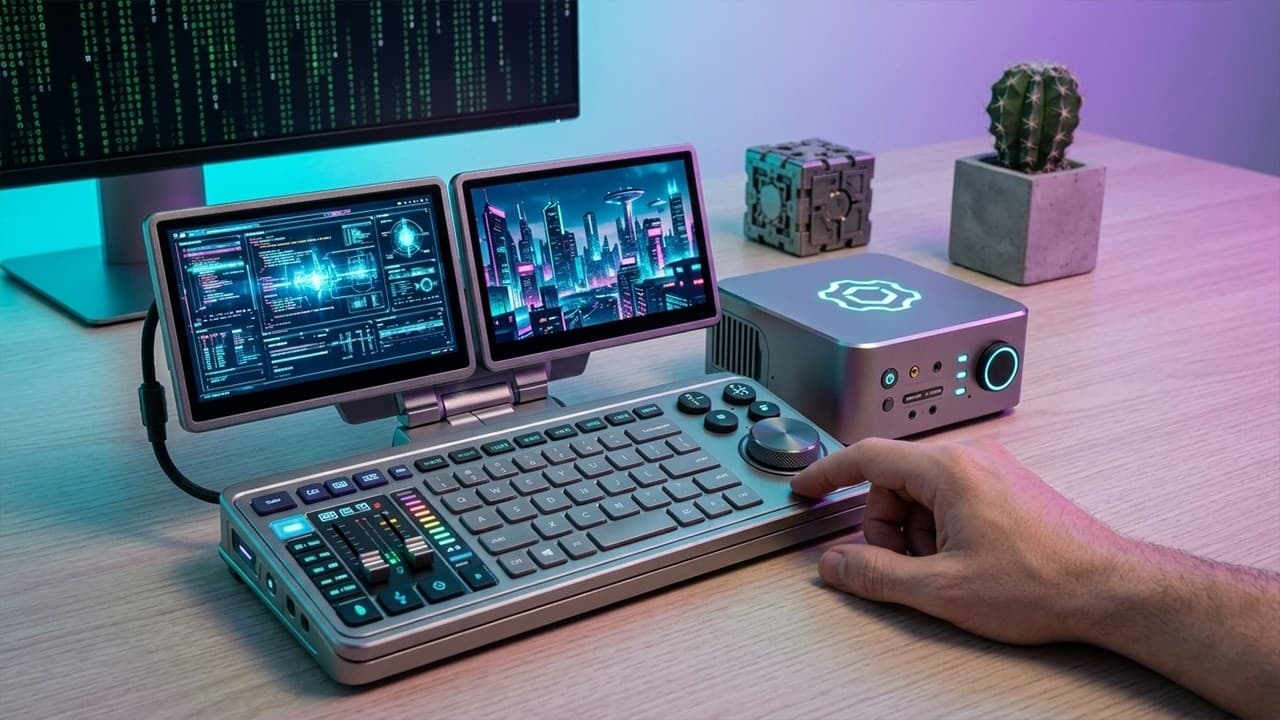
Two more worth flagging: the Z01 AI planning device — which runs GPT-5 at its core, syncs calendars, manages to-do lists, and acts as what the video calls "your personal chief of staff" [1] — and the Colonel Comm, which is possibly the most audacious form factor I've seen this year: a keyboard with a 12.5-inch ultrawide touchscreen, full AMD or Intel processor, up to 64GB DDR5 RAM, and up to 4TB SSD storage built directly into it. One device replaces your keyboard, secondary display, and potentially your whole desktop setup. Eight hours of battery. Hot-swappable mechanical switches [1]. That's not a gadget, that's a rethink of what a computer workstation even is.
The "Actually Useful" Tier
Below the headline-grabbers, there's a solid middle tier of products that solve real problems well.
The Core Plus power bank packs 27,000mAh, a full 200W AC outlet (supporting 110 and 220V), 140W USB-C fast charging, and a swappable battery system — all in something that supposedly fits in your hand [1]. If that's true at anywhere near reasonable weight, it's the power bank that replaces a backpack full of chargers for anyone who travels and works from the road. I'd want to hold it before believing the size claims, but the spec sheet is compelling.
The Pimax Dream Air SE VR headset deserves more attention than it'll probably get. Under 140 grams — lighter than most sunglasses. Micro-OLED displays at 2560x2560 per eye. 105-degree field of view. Eye tracking, hand tracking, spatial audio, 6DoF controllers [1]. VR has been fighting a weight and resolution battle for three years. If this ships as described, it's the first headset that doesn't feel like strapping a small TV to your face. For comparison, a recent unsponsored gadget review from WTE Solutions pointed to the Meta Quest 3S as the affordable AR standard for 2026 — at $499, it's still the accessible entry point, but the Dream Air SE is what the category looks like when it matures [2].
The Zoom/Saramonic Pro Plus C wearable recorder — 32-bit float, clip-size, IP67 waterproof, 16GB built-in, connects up to 10 units simultaneously — is a near-perfect product for journalists, documentarians, and content creators. 32-bit float means you can't clip the recording, which means zero-anxiety field audio [1]. That's a solved problem that's been annoying professionals for decades.
Unsponsored take: WTE Solutions (via YouTube) did a March 2026 gadget breakdown with no affiliate kickbacks and flagged three of the same product categories: Meta Quest 3S for affordable AR, Apple Watch Series 11 for health tracking, and AI-enabled wearables as the major theme of the year. When two independent sources converge on the same trends without any financial tie, that's signal worth noting. [2]
What's Hype Dressed Up as Innovation
Not everything in the Voltrix video earns the word "amazing." There's a category of gadgets in here that are genuinely well-made, visually beautiful, and deeply unnecessary.
The Tornado — an eco-friendly space heater and oil diffuser "crafted in Italy" with a "spinning flame" that "warms your space and fills it with fragrance" [1] — is a lifestyle product for the Instagram-home crowd, not a tech advancement. It's fine. It looks great. It has nothing to do with the future of technology.
The Polar lighter, machined from solid titanium or brass with a folding compass and mirror, is the lighter equivalent of a $400 mechanical keyboard — a premium object that does a simple job exceptionally well and mostly exists to signal that you appreciate craftsmanship [1]. Again, fine product. Not a gadget story.
The Berlino ice ball mold makes crystal-clear ice spheres that melt slower so they don't water down your whiskey [1]. That's it. That's the product. The YouTube packaging around it is doing a lot of heavy lifting.
I point these out not to be dismissive but because this is the filter work that gadget roundup videos don't do. Forty products in 25 minutes means you get maybe 30 seconds of context per item, which is exactly enough time for good marketing to look like good engineering. The heuristic I use: if the primary selling point is aesthetic (it's beautiful, it spins, it's made from titanium), it's a lifestyle product. If the primary selling point is a specific problem it solves better than the alternatives (32-bit float recording, no-clip audio, arm that picks up your socks), it's a tech product.
Voltrix's video has both. Knowing the difference is the whole job.
What 2026's Gadget Map Actually Shows
Step back from the individual products and look at the list as a dataset. AI shows up in: the desk lamp (learns your lighting preferences, syncs with music), the planning device (GPT-5 integration), the massage roller (adapts to your body automatically), the meeting speakerphone (transcribes and summarizes 99 languages), the desktop copilot (real-time AI across your workflow), the hologram companion (ambient AI with a face), and the robot vacuum (arm + navigation AI). That's seven of forty products with genuine AI integration — not marketing-speak AI, but AI doing something a previous-generation product could not have done [1].
That's the real story. AI didn't land in one flagship product. It dispersed across categories simultaneously, and the 2026 gadget market is the first one where that dispersal is visible at scale. Your $119 screwdriver doesn't have AI in it yet, but your $200 conference speaker does, and your $499 VR headset definitely does, and your robot vacuum is growing a mechanical arm.
For developers and builders, that's the interesting signal: the integration surface is everywhere. The application layer isn't just mobile apps or web apps anymore. It's physical objects, and the companies building those objects are increasingly hungry for AI layers that work reliably in hardware contexts. That's a different engineering problem than building a chatbot, and the market for people who can solve it is only getting larger.
Hat tip to Voltrix Gadgets for putting this list together — the curation across 40 products shows real range and the production quality makes it easy to see the hardware clearly. Full video on YouTube. [1]