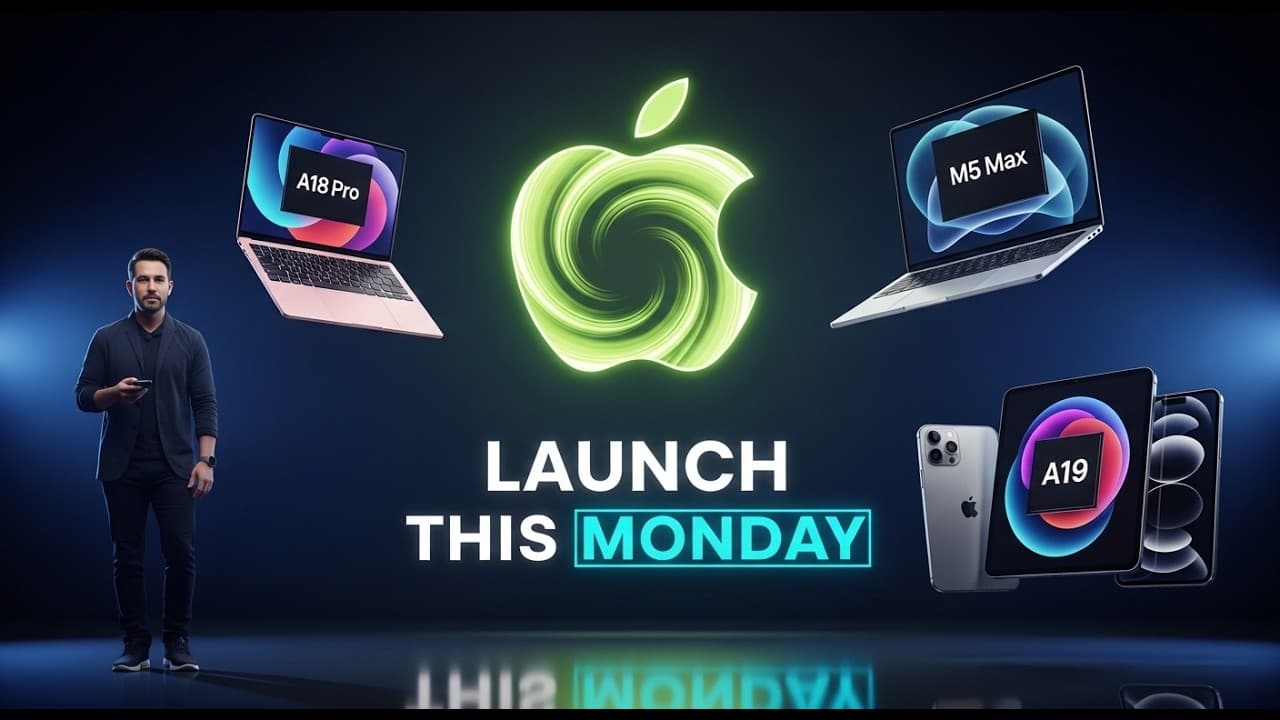
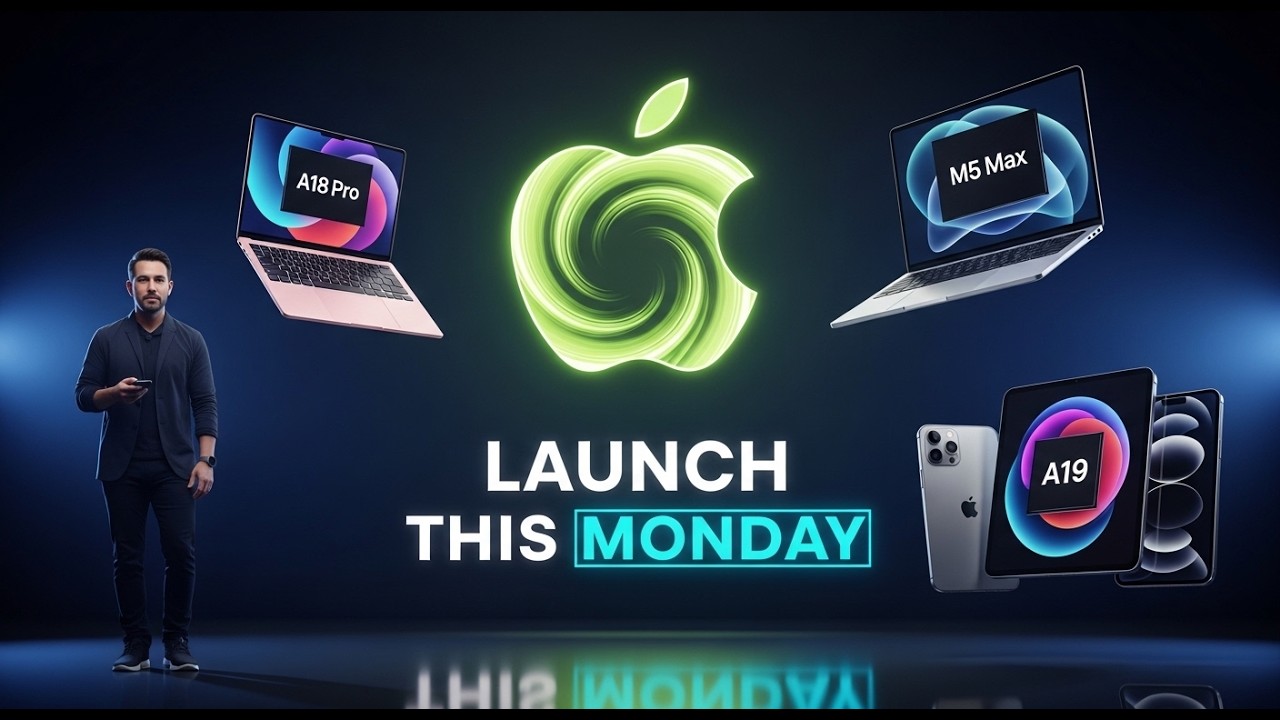
Apple's Big Week Starts in Hours. Here's What's Actually Coming.
No keynote, no stage, no Jony Ive slow pans. Apple is doing a rolling launch week starting Monday March 2 — dropping products one by one to keep the internet talking for days. YouTube already has the full breakdown. We read the transcripts so you don't have to: here's exactly what to expect, what it costs, and why this week matters more than a flashy event would have.
Apple March 2026 launch week breakdown — Innovate Tech Trends
Key Points
•Apple's March 2026 launch week starts Monday morning — no keynote, just a rolling series of press releases designed to keep every product in the spotlight for a full news cycle.
•iPhone 17e leads the charge: $599 starting price, A19 chip, Dynamic Island on a budget phone for the first time, 8GB RAM, and full Apple Intelligence support.
•11th-generation iPad gets a massive chip jump from A16 to A18 — bringing AI features to a $349 tablet for the first time. This is Apple democratizing intelligence at the entry level.
•A budget MacBook powered by the A18 Pro chip (not the M-series) could arrive at $599 — the cheapest Mac ever and a direct shot at Chromebooks in schools and corporate offices.
•iPad mini may finally get its OLED upgrade, plus a potential A19 Pro chip. iPad Air gets the M4. Apple is moving the entire lineup upmarket while holding prices steady.
No Stage, No Drama. Just Products.
It's Sunday night, and Apple is about to do something it has done exactly once before: skip the keynote and just start shipping news.
Starting Monday, March 2nd, Apple will roll out product announcements one at a time — a new press release each morning, products available to order that day, reviews landing in waves. Tim Cook posted a teaser animation on X last week confirming the cadence: "Starting next Monday." The invitation-only sessions in New York, London, and Shanghai aren't keynotes — they're hands-on product testing rooms. Apple wants the hardware to speak instead of a polished presentation.
YouTube channel Innovate Tech Trends broke this strategy down in a video published Sunday that's already gathering significant traction [1]. Their read: Apple loved what happened in 2024 when they rolled out the iMac, Mac Mini, and MacBook Pro across three consecutive days. Every product got its own headline. Nothing got buried. This week follows the same playbook, except the scale is bigger.
Three products are essentially confirmed. A fourth — the iPad mini's OLED upgrade — is strongly rumored alongside it. Here's the full breakdown of what's coming.
Innovate Tech Trends' breakdown of Apple's March 2026 launch week went up Sunday night and immediately started trending.
iPhone 17e: The Budget Phone That Finally Gets the Good Stuff
The iPhone 17e is leading Monday's announcement, and it deserves more attention than it's getting from the "budget phone" crowd.
At $599, you're getting the A19 chip — the same chip family as the flagship models, just with one fewer GPU core, which you would need a benchmark to actually detect. You're getting 8GB of RAM, which is the threshold Apple requires for Apple Intelligence to run on-device. And — most importantly for anyone who has been staring at the notch on an iPhone SE for three years — you're getting Dynamic Island [1].
That last part is the biggest deal for regular people. Dynamic Island isn't just an aesthetic change; it's Apple's way of surfacing live activities, timer notifications, music controls, and sports scores without you having to unlock your phone. It's genuinely useful, and until now it's lived exclusively on iPhones costing $799 and up. Dropping it to a $599 device signals Apple is done treating it as a premium differentiator and is ready to make it the new standard.
The N1 chip — Apple's in-house wireless silicon — is also reportedly inside, improving Bluetooth and Wi-Fi stability and Find My accuracy. Again: things you'd previously have had to buy an iPhone 16 to get. The 17e is not a corner-cutting device. It's last year's flagship feature set at a $200 discount, and that's exactly what the lower end of the market needs.
11th-Gen iPad: AI Comes to the $349 Tablet
The entry-level iPad hasn't seen a meaningful update in a while, and the 2026 refresh fixes that decisively. The jump from A16 to A18 is not incremental — it's the chip Apple put in the iPhone 16, which supports the full Apple Intelligence suite [2].
That means the $349 iPad gets AI-powered writing tools, smarter Siri, on-device photo editing, and all the rest of the Apple Intelligence stack that previously required an iPhone 15 Pro or iPad Pro to run. Apple is explicitly trying to make AI mainstream — not premium — and this is the most aggressive move in that direction yet [1].
The design doesn't change. Flat edges, USB-C, same compatible accessories. It's still an LCD, not OLED. Apple is keeping the bill of materials tight to hold the $349 price point. But the performance gap between this and the iPad Air narrows significantly — and for students, families, and anyone who just needs a reliable, fast tablet, the spec-to-price ratio on the 11th gen is hard to argue with.
The RAM bump to 8GB is equally important for longevity. Four-year-old iPads start showing their age when they can't hold apps in memory. 8GB of RAM on a $349 device should keep it feeling fast well into the end of the decade.
Apple is making sure every user has a fast and reliable device. The base iPad becomes the smart choice for everyone. The Air becomes the power choice for creators.
— Innovate Tech Trends, 'Every 2026 iPad EXPOSED'
The Budget MacBook: Apple Finally Fights for Chromebook Country
This one is the most interesting announcement of the week from a strategic standpoint.
Apple is reportedly releasing a MacBook — possibly 12.9-inch or 13.3-inch — powered by the A18 Pro chip rather than the M-series silicon found in MacBook Air and MacBook Pro. That's a phone chip running macOS, which is either brilliant efficiency engineering or a strange compromise depending on how you look at it [1].
The case for it: the A18 Pro is fanless, runs cool, doesn't need active cooling, and delivers excellent real-world performance for the cloud-first tasks this laptop is designed around. Web browsing, email, Google Docs, streaming — none of that needs M3 Pro compute. The A18 Pro handles it with headroom to spare.
The starting price is reportedly $599. This would be the cheapest MacBook Apple has ever sold, undercutting the entry MacBook Air by $300. It is a direct assault on Chromebooks in K-12 schools and corporate IT departments that have been choosing cheap Windows laptops and Chromebooks because Macs simply cost too much [1].
The compromises are real: no backlit keyboard, no TrueTone display, no fast charging, potentially only 128GB of storage at base. MacRumors has documented most of them [3]. This is Apple cutting costs deliberately to hit a price point, which is philosophically weird for a company that spent decades competing exclusively on premium quality. But the math is clear — if you can get someone into macOS at $599, you have a much better chance of upselling them to a $1,099 MacBook Air two years later.
Developer note: The A18 Pro in this budget MacBook shares its core architecture with the M-series chips, just without the same memory bandwidth and GPU core count. For basic development work — light coding, terminal sessions, running VS Code or a local server — it'll handle it. Where you'll feel the gap is Xcode full builds, Docker containers, or any virtualization work. For that, the MacBook Air M3 at $1,099 is the right answer.
iPad Mini OLED and Air M4: The Rest of the Lineup
Two more products round out what looks like the biggest Apple product week in recent memory.
The iPad Air is reportedly getting the M4 chip — keeping Apple's pattern of giving the Air last year's Pro silicon at a more accessible price. The M4 is a serious chip for creative work: video editing, music production, graphic design. The iPad Air with M4 would outperform most people's laptops while still fitting in a bag. Display and design stay the same — LCD, 11-inch and 13-inch options, Magic Keyboard and Apple Pencil Pro compatible [2].
The iPad Mini is the wildcard. Multiple leakers point to an OLED upgrade for the first time on Apple's smallest tablet — the same kind of per-pixel perfect blacks you get on iPhone Pros and iPad Pros, in a pocket-sized form factor. Add a rumored 120Hz ProMotion display and an A19 Pro chip, and the iPad Mini stops being the neglected family member and becomes a premium handheld device. The price likely goes up: from $499 to around $599. Whether that's worth it depends entirely on how much you need something that fits in a jacket pocket but performs like a pro tool [2].
There's also a wilder rumor about vibration-based audio on the Mini — using the body of the device itself as a speaker instead of grilles, which would enable better water resistance. That one is less confirmed, but if it lands, it's genuinely novel engineering.
Why This Week Matters More Than a Keynote Would Have
Apple doesn't need a polished presentation to move product. What it needs is for each announcement to get real estate in the news cycle, real hands-on time in the press, and real word-of-mouth from people who actually buy things.
The rolling launch format does all of that. By spacing announcements over three to five days, Apple gets a Monday story (iPhone 17e), a Tuesday story (iPad), a Wednesday story (MacBook), and so on. No product gets buried by another product's hype. Every device gets its own YouTube thumbnails, its own trending moment, its own Reddit thread.
But there's a bigger strategic picture here. Apple is creating what one analyst called a "budget trifecta" — a $599 iPhone, a $349 iPad, a $599 MacBook — that makes it possible to own the entire Apple ecosystem for under $1,600. That's still not cheap, but it's a different conversation than it was two years ago, when you were looking at $800 minimum for iPhone and $1,000 minimum for a Mac.
This week is Apple telling the world it's ready to compete at every price point — not just the top. Whether they've pulled it off without making compromises that feel too obvious is the question that reviews will answer over the next seventy-two hours. Either way, Monday morning is going to be a good time to be a tech journalist.