

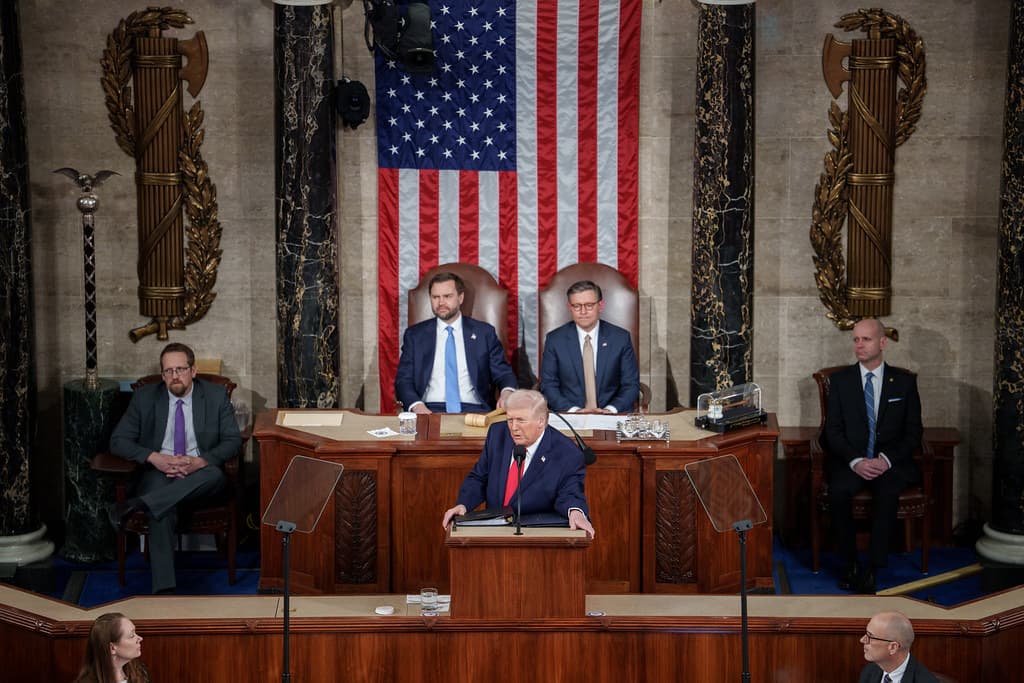
Presidents have always used the State of the Union to put the best possible frame on the preceding year. This is expected, understood, and largely harmless — a ritual of selective emphasis rather than fiction. Donald Trump delivered his address tonight in the full register of triumphalism, describing the "most secure border in American history," falling inflation, rising incomes, and something he called "the golden age of America." The applause lines landed. The framing was confident. And a conservative who actually wants this policy agenda to succeed is obligated to set the speech next to the week's other headlines and ask: how does it hold up? The answer, as with most things in politics, is complicated.
Credit Where It's Due
Start with what's working, because some things are. The administration can make a credible case on the border. Illegal crossings are down significantly from their peaks, and the combination of policy changes and deterrence has produced measurable results that even hostile analysts have had difficulty disputing. On judicial appointments — the long game of American conservatism — the record is strong. On regulatory rollback in specific sectors, there are genuine wins. The speech was not fabrication. It was selection. The challenge for serious conservatives is that selection cuts both ways. A strategy of only counting the wins eventually produces a movement that loses track of what isn't working — and can no longer course-correct when it needs to.
The Week the Courts Didn't Get the Memo
Four days before Trump took the podium to celebrate his economic record, the Supreme Court ruled 6-3 in Learning Resources, Inc. v. Trump that the International Emergency Economic Powers Act does not authorize presidential tariffs [1]. This is not a minor technical ruling. IEEPA tariffs were the central mechanism of the administration's trade policy. They were imposed under a declaration of economic emergency and generated approximately $133 billion in collections. The Court — including justices appointed by this administration — found the statutory authority simply wasn't there. The immediate pivot was to the Trade Act of 1974, with a temporary 15% global tariff now in effect. That is a legitimate tool, and the administration is within its rights to use it. But the substitution matters. Emergency powers carry different weight than statutory authority. The president's ability to rapidly escalate or calibrate tariffs in negotiating situations — the core of the America First trade strategy — is now operating on a narrower legal foundation than it was a week ago [2]. Meanwhile, the $133 billion question is before the courts. Importers who paid IEEPA tariffs now have grounds for refund claims. The legal exposure is real, and the administration spent the speech not mentioning it.