A Substack Post Just Wiped $2 Trillion Off the Software Sector
Citrini Research published a hypothetical AI doomsday scenario that went viral. On Monday, the software sector lost nearly $2 trillion. IBM had its worst day in 25 years. The article did not crash the market — it gave voice to the anxiety the market was already feeling.
The Article That Crashed The Market Today — YouTube video thumbnail
Key Points
•A hypothetical scenario from Citrini Research imagining an "AI intelligence crisis" in 2028 went viral with 20 million+ views — and helped trigger a brutal Monday selloff across SaaS, fintech, and payment stocks. [1]
•IBM had its worst single-day drop in 25 years (down 13%) after Anthropic announced Claude can modernize COBOL code. CrowdStrike fell 10%. DoorDash dropped 7%. Visa, Mastercard, and AmEx all took hits. The S&P Software & Services index is down nearly 20% year-to-date. [2]
•Nvidia was green on the day — up about 1% while the S&P dropped 1% — because the market's logic is simple: if AI kills everything else, the company selling the weapons still wins. [3]
•The article didn't crash the market by itself. It crystallized something the market was already feeling: the AI foundation model companies don't just want to be back-end APIs. They want the customer. And that's what's actually terrifying enterprise software. [4]
A thought experiment walked into a stock exchange.
Let's get something out of the way: a Substack article didn't crash the stock market. That's a fun headline, but it's not how markets work. What actually happened on Monday is more interesting and more concerning.
Citrini Research — a finance newsletter with a solid following — published a hypothetical scenario called "The 2028 Global Intelligence Crisis." [4] It's a thought experiment, not a prediction. The authors say that explicitly in the first paragraph. The premise: what if AI gets so good, so fast, that it displaces enough white-collar workers to trigger a consumer spending crisis, a mortgage market repricing, and a 38% S&P drawdown by mid-2028?
The piece went viral. Twenty million views. Michael Burry — the "Big Short" guy — called it an "interesting thought experiment." [1] And on Monday morning, the market woke up and chose violence.
The damage report
The S&P 500 dropped about 1%. Not catastrophic on its own. But underneath the surface, specific sectors got absolutely demolished.
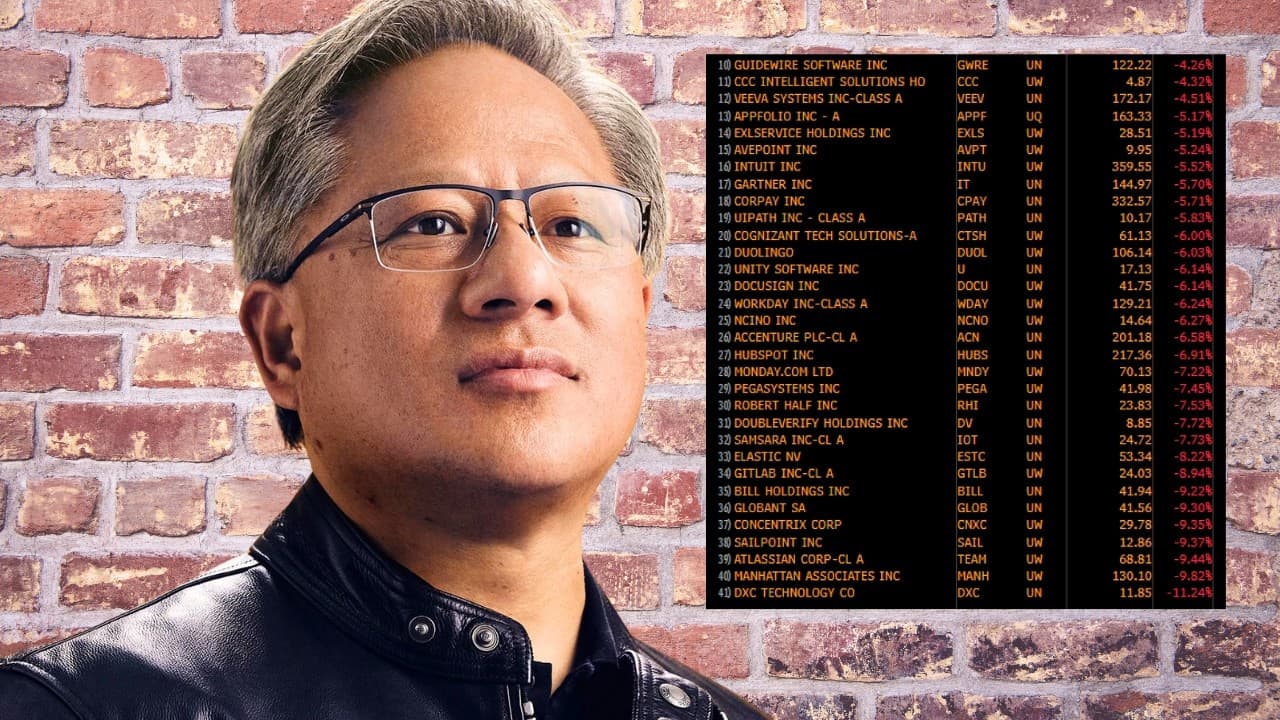
Software stocks took the worst of it. The S&P Software & Services index is now down nearly 20% year-to-date — the largest non-recessionary drawdown in over 30 years, according to JPMorgan. [3] Microsoft is basically in a bear market, down 18% on the year. Salesforce hit a 52-week low. The iShares Software ETF (IGV) dropped almost 5% in a single session.
Then there's IBM. Down 13.4% in one day — its steepest decline since October 2000. [2] The catalyst wasn't the Citrini article. It was Anthropic announcing that Claude can now automate COBOL modernization on IBM mainframes. COBOL — a programming language created in 1959 that still runs a staggering amount of enterprise infrastructure. IBM has built billions in consulting and migration revenue around the complexity of maintaining legacy COBOL systems. Claude just told the market that complexity might be optional now. Thirty billion dollars in market cap evaporated in a few hours. [2]
CrowdStrike fell 10% after Anthropic's Claude Code security feature announcement on Friday compounded into Monday's panic. [2] DoorDash dropped 7% despite reporting one of its best quarters for average order value. Uber fell 4%. Visa, Mastercard, and American Express all took significant hits as the Citrini article specifically hypothesized stablecoins with agentic commerce replacing traditional payment rails. [1]
Monday's selloff hit software, fintech, and payment stocks hardest — while Nvidia somehow finished green.
The one stock that didn't care
Here's the part that should make you think: Nvidia was green on the day. Up about 1% while the S&P dropped 1% and the software sector lost hundreds of billions.
The market's logic is almost poetic in its brutality: if AI is going to commoditize everything, then the company supplying the compute for that commoditization is the only safe bet. The Citrini article itself says as much — Nvidia is essentially the only buy in their apocalypse scenario. [1]
Nvidia reports earnings Wednesday, and the setup is fascinating. The stock trades at 24x earnings against a 5-year average of 38x. Street consensus expects about $65 billion in revenue. Most analysts think they'll guide closer to $74-75 billion. TSMC just increased capex by $14 billion. A100 and H100 GPU rental prices — for chips that are six years old — are at their highest levels in years. [3]
The demand for compute isn't slowing down. If anything, every AI announcement that kills a SaaS stock is another data point that more compute is needed. Nvidia is the arms dealer in a war where every side needs weapons.
What the article actually got right
Strip away the viral headlines and the 2028 doomsday framing, and the Citrini piece touches on something real that the market has been struggling with for months.
The core insight isn't that AI will cause 10% unemployment by 2028. That's the speculative part. The core insight is about what happens when AI foundation model companies decide they don't want to just be APIs.
Think about it from Anthropic's perspective. Right now, they sell API access to companies like Salesforce, CrowdStrike, and Adobe, who integrate Claude into their products and charge their customers a premium. But why would Anthropic keep doing that when they could go directly to those customers, offer a better product, and charge less? [4]
Anthropic doesn't have 20,000 salespeople. They don't have decades of enterprise bureaucracy. They have AI engineers building products at a speed that traditional software companies can't match. If they decide that a CRM isn't that complicated — and let's be honest, it isn't — what stops them from building one and undercutting Salesforce on price while capturing the customer relationship?
This is the actual fear driving the selloff. Not a hypothetical 2028 crisis. The real, present-tense realization that the moats software companies have built over the last decade — customer lock-in, switching costs, network effects, enterprise relationships — might not hold against a competitor that can replicate your product in weeks and give it away for less.
What it got wrong
The article's weakness is the same weakness most bear cases have: it assumes the worst-case scenario plays out linearly without adaptation.
History doesn't work that way. The automobile didn't just kill the horse industry — it created the auto industry, gas stations, suburbs, highways, motels, fast food, and eventually the entire modern logistics chain. The internet didn't just kill newspapers — it created Google, Amazon, social media, the creator economy, and SaaS itself. [5]
AI will absolutely displace jobs. That part isn't controversial. But the assumption that displaced workers simply stop spending and the economy enters a death spiral ignores every historical precedent we have about technological disruption creating new categories of work and value.
The Citrini piece introduces a concept called "ghost GDP" — AI-boosted output that inflates metrics but doesn't circulate as human spending because "machines spend zero dollars." [4] It's a clever framing, but it assumes that the productivity gains from AI don't flow back to humans through cheaper goods, new services, or entirely new industries we can't predict yet.
Noah Smith, writing on Noahpinion, called it "a scary bedtime story" that overemphasizes disruption without accounting for the creative destruction that historically follows. [5] He's probably right in the long run. But in the short run, markets trade on fear, and this article gave the market a very specific fear to price in.
The real question nobody's answering
Here's what I keep coming back to: the market isn't really afraid of 2028. It's afraid of right now.
Every week, Anthropic or OpenAI or Google announces something new. Claude can do security. Claude can modernize COBOL. Claude can write code. Gemini can make your thumbnails. GPT can analyze your data. Each announcement is a small cut. And the software sector is bleeding from a thousand of them.
The question isn't whether AI will eventually reshape these industries — it will. The question is whether the incumbents can adapt fast enough to capture the value from AI rather than lose it. Salesforce is integrating AI. Adobe is integrating AI. CrowdStrike is integrating AI. But the market isn't giving them credit for it because the fear is that integration isn't enough when the foundation model company can just do it all themselves.
That's the tension Nvidia's Jensen Huang has to navigate on Wednesday's earnings call. He needs compute demand to be insatiable — that's his business. But he also needs the broader software ecosystem to survive, because those companies are his customers' customers. If the entire SaaS layer collapses, the AI infrastructure story gets a lot more complicated.
Where this leaves us
The Citrini article didn't crash the market. The market crashed itself because it's sitting on a pile of unresolved anxiety about what AI means for the business models that have driven tech valuations for the past decade.
A $2 trillion wipeout in software stocks isn't a rational response to a hypothetical Substack post. It's the market telling you it doesn't know how to price the future anymore. And when markets don't know how to price something, they sell first and figure it out later.
Nvidia earnings Wednesday will matter. Not because the numbers will be bad — they won't — but because Jensen has to thread the needle between "AI is so powerful it needs unlimited compute" and "AI isn't going to destroy every other company in our ecosystem." That's a hard story to tell when the evidence keeps pointing in one direction.
For now, the only consensus the market has reached is this: the picks-and-shovels play is safe. Everything else is a question mark. And a 20-million-view Substack article just made that question mark a lot bigger.